Predators Update

vlcsnap-2549636

One of the greatest movie monsters of all time is getting the Reboot treatment, as Robert Rodriguez (Sin City, Desperado, Spy Kids) is producing and developing the new Predator film, PREDATORS.

Hired to helm the flick is rising director Nimrod Antal, who’s films do not properly reflect his name: the man has some intelligence with his work as he has proven succesfully with KONTROLL and ARMORED. Even Vacancy, though simplistic, wasn’t that bad. Mostly thanks to Luke Wilson, but the directing was solid.

However, I’m still not completely sold on this guy. With Rodriguez behind the scenes, at least we KNOW 100% it will be full of cool stuff–explosions, violence, and maturity (of at least the masculine variety).

However, its also the plot synopsis that I’m unsure of at this point. From the interview with Rodriguez himself:

I can’t go too much into the story right now, because we’re still writing. But it still involves a very intense group of people stranded on a Predator planet discovering unspeakable horrors (that are not always from outside their group). So like the original movie, the title does have a double meaning.
Aliens was a different take on the Alien idea, and an original movie in it’s own right, and that’s what we want to do with this.

Aint it Cool News has the full story, so you should check out the link here.

Greatest Thing Ever

I just wanted to let you all know. This video featuring THE MAN HIMSELF is absolutely brilliant. This is the exact thing I am talking about in my Citizen Kane essay on Meta-textuality. Absolutely brilliant.

Spoilers
My favorite media theory (One I slightly self-developed) is meta-intertexuality. Its basically about how a movie is affecting you based on the medium it is conveying based on the medium the characters operate under base on how the director manipulates that medium. And how you know you’re watching a movie about a movie (or reading a book about a book) about a film maker making a movie or a news paper writer writing a newspaper being demonstrated in news reels. Furthermore, it is about how it effects you specifically because of the medium in which its conveyed via its levels of didactic truth or angles of emotional involvement.

In this case, its Kojima doing a kitcshy video about Kojima’s home-made kitchsy stuff (the ridiculous looking MGS universe, which I love but has become a tad overdone), where the coolest thing is just running around ridiculously pretending your stealthy when in reality, the AI is just too dumb to notice you or doesn’t care, knowing that he’ll probably get away with it because, in all honesty, most people just don’t care, and that its funny because we do it just because we feel cool doing it. That’s the whole reason. He just…he knows.

Especially because, up until that point, the video really sucks. No offense guys at Mega64. I’m sure that was your intention. The trigger-happy-TV video game approach is, as always, beautiful, but I know you’re just being self-referential to your own previous material, hence the disappointment in your characters’ eyes when they meet their Maker. They know they’ve been caught in a running gag, just as the series of MGS has, itself, become.

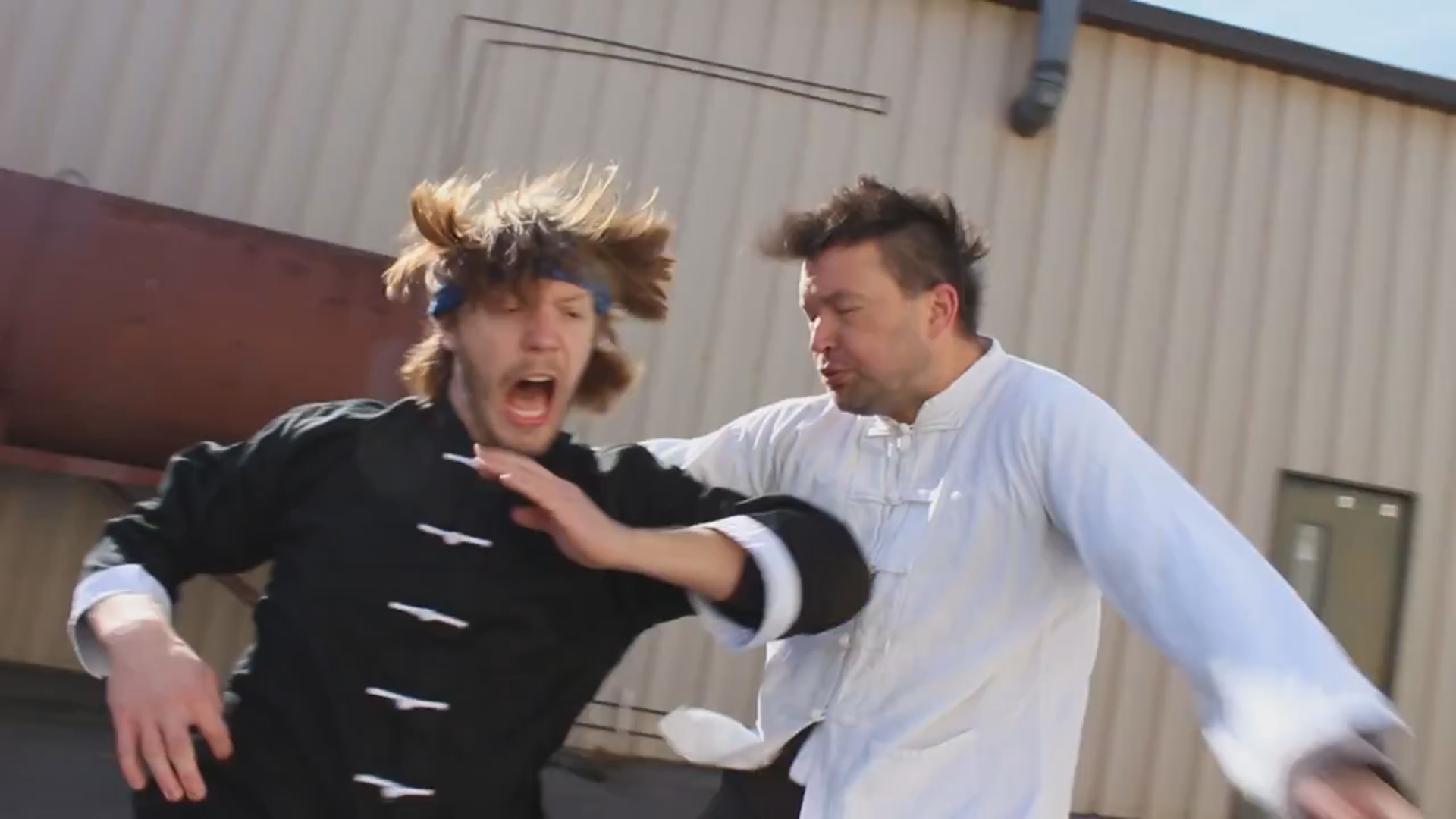
More posts will be coming later, but are coming in slowly, seeing as I have become a Stunt Pirate somewhere I can’t say, and that I have a lot going on this summer, including Kung Fu training. No joke.

I know this site has been experiencing some “down time” in regards to posts, updates, etc. Well, there’s a few things I’d lke to bring up and let you in on.

1) Why am I late on posting more often? Well, one word: College. Second word: Essays. So I’ll start by posting something for you all by the end of the post.

2) Go to the films page. Now. You’ll see that we haven’t abandoned ship on producing content. I have recently put up a new film, CONFLICT NOW, that will show you what we were made of two years ago. Official post to come soon.

3) Go to the Essays section. Thanks to Ryan, we’ve got a lot of them posting on a regular basis, from my resevoir of nearly 50 critical film essays (not reviews). Read em, love em, learn something.

Here’s an example of one, and what I’ve been working on right now. Its just an abstract, really, but what it will communicate is the basic idea of a Feminism/Realism article I’m writing comparing Leon the Professional to Thelma and Louise.

A dark, brooding figure is sitting at a table, cleaning out his pistol. A little girl approaches him and begins an argument. She tells the man that she wishes to be a “cleaner” a hitman, or in this case, hit-girl. The older man, not wanting to assume any responsibility, offering her the goodbye gift of a gun, and clearly knowing this girl cannot possibly handle the job, tells her “Go away, I work alone.” Her immediate response is childish, unrealistic, and most importantly: full of conviction and accuracy. “Bonnie and Clyde didn’t work alone. Thelma and Louise didn’t work alone. And they were the best.” Even though her argument is based on works of fiction (let us assume she has no idea about the real lives of Bonnie and Clyde), it speaks of her aspirations, and of a worldly, referential knowledge that could produce such an attitude. Matilda, the little girl, tells him that if he doesn’t help her to become like these fantastic figures (through his training, no less), that she will surely die, almost immediately. The man, Léon, tells her “You’re just a little girl, don’t take it badly but, I just don’t think you could do it.” The scene is capped off by Matilda taking the gun offered at the start of the argument, standing up blankly, and firing it out the window in random directions without any concern for the safety of the world. “How’s that?” Matilda says, rhetorically, as Léon gazes upon her, unable to respond. There is an air of terrifying awe, as this little girl, motivated by revenge and guided by the media, has proven that a little girl may be able to play with the big boys.

So, here’s an idea, would readers like more of this style of writing on the site? If, over the summer, I could produce maybe 3 updates like this a week, and make it something called, “FAVORITE SCENES” would you be interested? Lemme know in the comments. Also- we can turn this into a competition: readers can write in examples of their own “Favorite scenes” up to…eh let’s say 300 words, and at the end of each week, maybe, I’ll try and get them posted. Winners will recieve bragging rights and at the end of the month a special prize from me. Let’s try that out…starting…NOW. (End of the month being June, duh).

Back to writing this paper. See you out there in internet land.

Essay: The Untouchable 80s

Adding another entry to our essay’s section is an issue of historical fiction, wherein it is a historical event portrayed in a fictional way…or is it fictional history? Well you comment and decide. Anyways, essay is about the significance, accuracy, and entertainment value of Brian DePalma’s 1987 film, The Untouchables. This essay saved my grade in my Studies in Popular History 490 level class.

Brian DePalma’s “historical” crime film, The Untouchables, was released in 1987, well into a decade well known for excess. The story of the film takes place during 1930’s Nation-wide Prohibition, in which American citizens were restricted by law from buying, selling and consuming alcoholic beverages. This was much to the chagrin of bar tenders, but gave the crime lords of the central United States a large market to work with: crime syndicates, lead by men like Al Capone, secured a profitable black market in liquor sales. The story of the film starts with real-life historical figure, Eliot Ness, bringing his “tin star” to a town full of corrupt officials and gun wielding Mafioso. Chicago, Illinois was the headquarters of the real life Al Capone, and Elliot Ness did in fact start his war and end Capone’s reign in that very city. However, aside from the general setting, the two leading opponents, and the final court case resulting in the arrest of Capone, the heavy weight bought on this stage is mostly a dramatic fabrication of the events that could have (or never did) take place.

You can read the full essay here.

Essays Section Now Up!

We have another special surprise for everyone out there on the net, STRIKE A POSE FILMS now introduces it’s Essays Page, a place where you can read and gain cinematic terminology and knowledge from the writings of Dylan Hintz and others.

So two things are happening with this page: One, its a portfolio of my years of paper writing at Salisbury University under the great tutelage of Dr.’s Walker, Johnson, Moeder and others, as well as some private essays I’ve written in my free time. They can be cited if you are ever faced with writing an essay of your own on films like Oldboy, Cache, Aliens, The Talented Mr. Ripley, Rashomon, Gattaca and Life is Beautiful. There is a creative commons notification at the bottom of each essay, so please keep that in mind.

Secondly:
If you wish to get your essay published on a fully-functional and well-read website, please by all means submit it via email to my gmail account, which is just “strikeaposefilm” @ gmail.com.

Here is a sample of my essay on the film The Battleship Potemkin:

Dylan Hintz
English 402, Film History
Professor Johnson

The Warfare of Montage

“Revolution is war,” begins a famous quote from Soviet Revolutionary Vladimir Lenin in the opening slate to Sergei Eisenstein’s 1925 masterpiece of Soviet Montage, The Battleship Potemkin. This statement links clashing close up images of water crashing upon rocks- a natural violence of warlike proportions displayed to give the viewer a feeling of great chaos- to the entirety of the film in a message and theme of collision and amassed disturbance. This quote, delivered through a black and white slate of words and expressing the emotions of the time towards warfare, explains in Lenin’s own words how something of great change, a Revolution, can only come through the great destruction of War. Two juxtaposed ideas, change and destruction, give a concise and explosive example of Eisenstein’s film theory of Montage, most prominently displayed in The Battleship Potemkin. When put together in a subconscious mindset, the words can create an idea of revolution and war- the fulfillment of the formula he created. Eisenstein carries over this equation of words to the medium of film and the images it can convey in the succession of editing- the ultimate storytelling power of a film. He carves out the themes of this film through the use of conflict to convey images within the montages, giving deeper meaning to scenes as well as providing an artistic angle to almost documentary-like situations.

There is one key scene in the Potemkin story that depicts its primary revolution through the use of a heavily edited montage. During the second act of The Battleship Potemkin, the captain has called all sailors and soldiers to the deck to demand information on possible treason. The treason in question is based around a paranoid request: Did the sailors enjoy their meal? In the oppressor’s, the pristinely clothed and thick mustached captain, view had they not, they are obviously denying the consumption of the provided food in an act of rebellion against their suppliers and should be duly punished for such treason. Thus starts the most dramatic montage of this act as the soldiers prepare to fire on the dissenters in following their captain’s orders. In a slow build of solid images, the marines raise their guns in preparation to fire upon the dissenting sailors. Displaying a solemn acceptance of the doom draped upon them, the sailors lower their heads in shame and despair as the rifles are pointed upon their brothers. It is in a slow and breathe-like take that Vakulinchuk, in a dramatic medium shot, is the only man to raise his head upward and take in the image of the oppressive act. The angles then conflict, as victory appears on the side of the oppressors, with their shots being taken from a low angle, putting their guns in the top of the frame, with the cloaked men kneeling towards the bottom of their frame from a high angle, accepting their doom.

You can read the rest of this essay here, and check out the rest at http://www.strikeaposefilms.com/essays

Feel free to comment and let me know your thoughts. These papers are primarily for analysis, not argument, but if you agree or disagree a discussion is more than welcome- it is encouraged.

As I start adding more essays I will be posting them to the main page as well, so more content to look forward to for the next couple of months.

Thanks for paying attention and enjoy the literature!

Page 1 of 3012345»...Last »